
 Talk To Astrologer

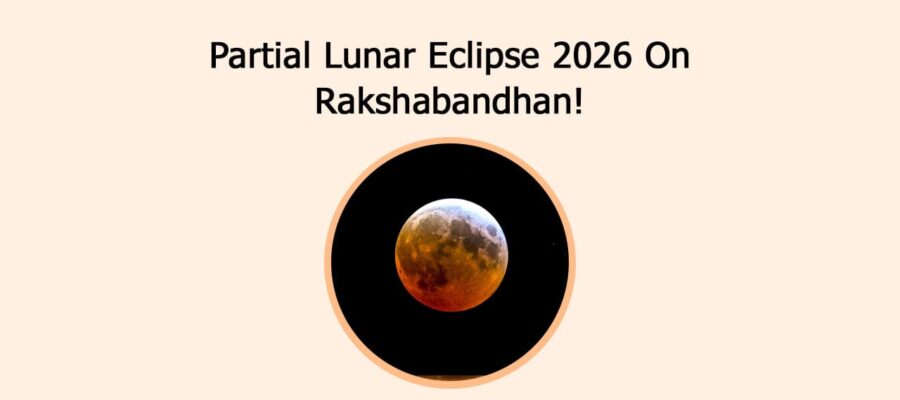
Partial Lunar Eclipse 2026: August 2026 is witnessing a rare celestial phase as two eclipses occur within just sixteen days of each other. Adding to its significance, the Partial Lunar Eclipse on 28 August 2026 coincides with Rakshabandhan, making many people curious about its visibility, Sutak Kaal, and astrological impact. In Vedic astrology, when a solar and lunar eclipse occur within approximately 15 to 16 days of each other, this period is called Eclipse Season.

Through this special blog by AstroSage AI, we will tell you everything about the Partial Lunar Eclipse 2026 along with its correct date, time, the zodiac sign and Nakshatra it falls in, whether it is visible in India, whether Sutak applies and what this eclipse means from an astronomical perspective.
To Know More About This Day, Talk To The Best Astrologers!
Partial Lunar Eclipse 2026: Date And Time
According to the Hindu Panchang, the second Lunar Eclipse of the year 2026 will occur on 28th August, 2026 on the Purnima Tithi of Shukla Paksha in the month of Shravana. During this Partial Lunar Eclipse 2026, the Moon will be positioned in the Aquarius zodiac sign and the Shatabhisha Nakshatra. Below are the confirmed timings as per Indian Standard Time:
Eclipse Begins: 08:04 PM IST
Maximum Eclipse: 9:43 PM IST
Eclipse Ends: 11:22 PM IST
Duration: 3 hours and 18 minutes
Free Online Birth Horoscope
Partial Lunar Eclipse 2026: Visibility In India & Worldwide
The Partial Lunar Eclipse on 28 August 2026 will not be visible in India, as the Moon will remain below the horizon throughout the entire eclipse. For instance, in Delhi, the Moon is expected to rise at around 06:54 PM IST, by which time the eclipse will have already ended.
As a result, cities such as Delhi, Mumbai, Kolkata, Chennai, Bengaluru and the rest of India will witness normal daylight during the eclipse.
No Sutak Kaal In India: Since the eclipse will not be visible in the country, no Sutak Kaal will be observed, and all religious rituals, auspicious ceremonies, temple worship, and daily activities can continue without any restrictions. This is especially significant as Rakshabandhan 2026 falls on the same day, allowing devotees to celebrate the festival and perform all associated rituals without any interruption.
Visibility Across The World: While the eclipse will not be visible across most of Asia, including India, China, Southeast Asia, and Australia, it will be observable from several parts of the Americas, western Europe, and western Africa. In the United Kingdom, viewers will be able to witness the initial phases of Partial Lunar Eclipse 2026 with the maximum eclipse occurring at 05:12:52 AM BST.
AstroSage AI Brihat Horoscope For All The Valuable Insights Into The Future!
Know The Meaning Of Partial Lunar Eclipse 2026
The Lunar Eclipse happens when the Earth comes between the Sun and the Moon, casting its shadow on the Moon. There are three types of Lunar Eclipses; Total Lunar Eclipse, Partial Lunar Eclipse and Penumbral Lunar Eclipse.
Total Lunar Eclipse: During the Total Lunar Eclipse, the entire Moon moves into the Umbra of the Earth which is the darkest and the innermost part of its shadow causing the Moon to appear reddish or coppery.
Partial Lunar Eclipse: During the Partial Lunar Eclipse, only a portion of the Moon enters Umbra, while the remaining part stays illuminated, making part of the Moon appear dark.
It is worth noting that the Partial Lunar Eclipse on 28 August, 2026 is especially remarkable because at its maximum, approximately 96% of the visible surface of the Moon will be covered by the Earth’s shadow. This makes it an exceptionally deep partial eclipse, appearing almost like a total lunar eclipse to observers in regions where it is visible.
Penumbral Lunar Eclipse: During this phase, the Moon passes only through the Penumbra of the Earth which is the lighter outer part of the shadow. As a result, the Moon appears slightly dimmer, and the eclipse is often difficult to notice with the naked eye.
Astrological Significance Of Partial Lunar Eclipse 2026
Although the Partial Lunar Eclipse on 28 August 2026 will not be visible in India, it still holds considerable significance in Vedic astrology due to its unique planetary alignment.
During the eclipse, the Moon will be positioned at 10°37′ in the Aquarius zodiac sign in Shatabhisha Nakshatra, while the Sun will be placed directly opposite at 10°40′ in Leo in Magha Nakshatra. Astrologically, this combination is particularly noteworthy because Shatabhisha Nakshatra is ruled by Rahu, whereas Magha Nakshatra is ruled by Ketu. Thus, both luminaries; the Sun and the Moon will occupy Nakshatras ruled by the lunar nodes during the eclipse.
In Vedic astrology, Rahu and Ketu are the primary forces behind eclipses. When the Sun and Moon are simultaneously placed in Nakshatras ruled by these shadow planets, the eclipse is believed to carry heightened karmic energy. This eclipse also builds upon the energies of the Total Solar Eclipse on 12 August 2026, further intensifying the process of inner growth and self-reflection.
Furthermore, the Moon governs the mind, emotions, and inner peace. During a Lunar Eclipse, its nurturing influence is believed to be temporarily affected, making this a favourable period for introspection and spiritual practices.
Click here to buy gemstones, Rudraksha and other astrological products: AstroSage AI Shop
Meaning Of Partial Lunar Eclipse 2026 Occurring In Shatabhisha Nakshatra
The Partial Lunar Eclipse 2026 occurs in Shatabhisha Nakshatra, the 24th Nakshatra in Vedic astrology, which spans Aquarius. The name Shatabhisha translates to “a hundred physicians” or “a hundred healers,” symbolising the power of restoration, discovery and wisdom.
Ruled by Rahu and presided over by Varuna, the Vedic deity of cosmic order and vast oceans, Shatabhisha is known for its connection with truth, discipline, research, science, medicine, and spirituality. People influenced by this Nakshatra are often considered analytical, independent, and inclined towards uncovering hidden knowledge.
As the Partial Lunar Eclipse 2026 is taking place in this Nakshatra, its influence is expected to be more prominent for natives born under Shatabhisha, Ardra, Swati, Dhanishtha, and Purva Bhadrapada Nakshatras. These natives may notice significant developments or shifts in different aspects of life during the eclipse.
Get New Year’s Predictions Yearly Horoscope 2026
Remedies During The Partial Lunar Eclipse 2026
Those who wish to make the most of the spiritual significance of the Partial Lunar Eclipse 2026 may consider the following remedies:
- Chant “Om Som Somaya Namah”, the Chandra Beej Mantra, to promote emotional balance, mental peace, and inner stability.
- Also, recite sacred Mantras such as “Om Namo Bhagwate Vasudevaya” or “Om Namah Shivaya” with faith and devotion to seek divine blessings.
- Natives should spend time in meditation, prayer, or self-reflection, as eclipse periods are considered favourable for spiritual growth and inner awareness.
- People should also perform charity by donating clothes, food, grains or other essential items according to their capacity, as it is regarded as highly auspicious.
- Natives are also suggested to maintain a calm and positive mindset by avoiding unnecessary conflicts, negative thoughts and impulsive decisions during this period.
For Astrological Remedies & Services, Visit: AstroSage AI Online Shopping Store!
We hope you liked our blog. Thank you for becoming an important part of the AstroSage AI family. For more interesting blogs, stay connected with us!
Frequently Asked Questions
It will occur on 28 August 2026.
No, it will not be visible across India.
No, Sutak Kaal will not apply in India.